
Posted: March 26, 2026 | admin
Sometimes men experience difficulties in their intimate lives. For example, they experience decreased libido or erectile dysfunction. Sometimes they notice a loss of muscle mass, forcing them to work harder to maintain their physical fitness. Men also suffer from mood swings, fatigue, increased sweating, and decreased bone density. This may be related to hormones, most likely a decrease in testosterone.
This is where hormone therapy for men comes in. It’s always controversial. Some praise it, others fear it. Although research has long proven that it can reduce the risk of heart disease and diabetes, many still approach it with caution. Let’s discuss all the nuances of men’s hormone treatment. And you can make an informed decision.
With age, testosterone levels in men decline—this is normal. Therapy is not needed to add anything supernatural. It’s simply a way to return hormones to their normal, healthy levels. The prevalence of testosterone deficiency increases with age. It affects 20 percent of men over 60, 30 percent over 70, and 50 percent over 80. Scientists have calculated that 18% of men over 70 already have significantly low testosterone. This directly affects metabolism, which, in turn, increases the risk of stroke and high blood pressure. Male hormone replacement therapy helps reduce these risks.
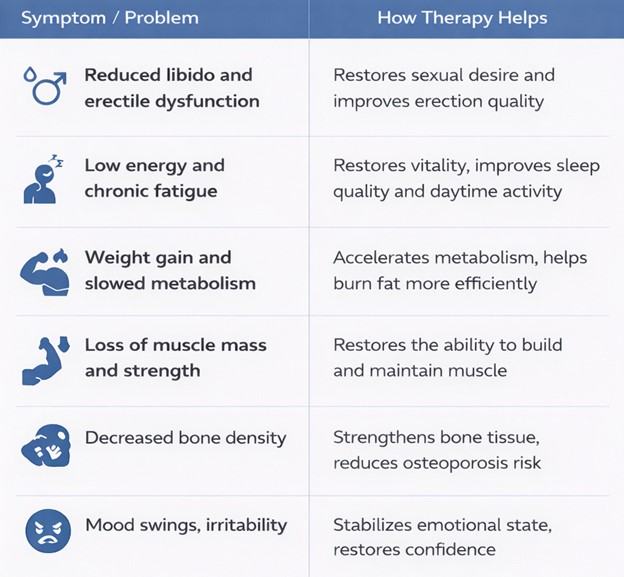
Here are other benefits of normalizing testosterone levels:
The heart contains numerous testosterone receptors, and weakening of the heart muscle is sometimes associated with low testosterone. Testosterone is responsible for the synthesis of heart muscle protein, controls coronary artery function, and helps maintain healthy cholesterol levels. Therefore, low testosterone is often associated with an increased risk of heart attack and stroke. Doctors call these “metabolic risk factors.” By normalizing hormone levels, a man reduces these risks and gains the chance of a longer, healthier life.
When testosterone levels drop in an organism, energy is the first to suffer. A person can feel sluggish and apathetic, and it becomes increasingly difficult to perform daily activities. Low testosterone often disrupts sleep. It leaves a person feeling tired when they wake up. Men lose the desire to exercise or go for walks, and, as a result, problems with eating and excess weight begin. Therapy helps break this vicious cycle and restore a man’s energy. A person feels that his youth has returned.
The connection between the endocrine system and a person’s appearance is profound. When testosterone levels drop below the physiological norm, a cascade of metabolic disturbances is triggered, directly altering body composition. Testosterone is one of the key modulators of the basal metabolic rate. It regulates the efficiency with which the body converts consumed calories into energy. With androgen deficiency, the metabolic activity of tissues naturally decreases. Even a habitual, unchanged diet begins to lead to fat accumulation. Therapy helps return weight to normal.
Testosterone has a pronounced anabolic effect on muscle tissue. It stimulates protein synthesis and helps maintain muscle mass and strength. As testosterone levels decline, anabolic signals weaken, leading to gradual muscle fiber atrophy. Muscle mass gives way to fat tissue because the body has lost the necessary hormonal stimulus to maintain it. Loss of muscle mass further slows metabolism. Therapy can break this vicious cycle.
Testosterone’s influence also extends to the skeletal system. It participates in bone remodeling processes, promotes calcium retention, and maintains bone strength. Osteoporosis is traditionally associated with postmenopausal women, but in men, prolonged and severe testosterone deficiency is also a risk factor for decreased bone density. This process is asymptomatic but has long-term consequences for the musculoskeletal system. Hormonal replacement therapy in this context restores the deficiency to physiologically normal levels, thereby restoring impaired regulatory mechanisms.
Sometimes, due to hormonal imbalances, men begin to develop breast enlargement (called gynecomastia). This occurs when estrogen levels become too high compared to testosterone. Hormone therapy can also help correct this. It can also slow or stop hormone-related hair loss.
When testosterone levels drop, libido fades. This is a normal reaction. Men notice a loss of desire and erectile dysfunction. Sexual stimulation and erections begin in the brain. Free testosterone triggers sexual desire and controls both the physical and mental aspects of the process. Testosterone receptors initiate a series of biochemical reactions that involve receptors in the nervous system, blood vessels, and muscles.
Insufficient free testosterone impairs a man’s sex life and causes genital atrophy. However, testosterone levels can be restored with therapy. When can positive changes in genital function and size be expected?
The man’s relationships improve. Furthermore, he feels a return to self-confidence. It should also be noted that erectile dysfunction can sometimes be caused by factors unrelated to hormonal balance. For example, arteriosclerotic blockage of the blood arteries in the penis may be a possible cause. A competent doctor will determine the cause and prescribe treatment.
Hormonal therapy for androgenetic alopecia can halt hair loss and partially restore hair growth. It blocks the effect of dihydrotestosterone on the follicles. Unfortunately, therapy is ineffective in cases of complete hair loss. However, with early treatment, symptomatic treatment of androgenetic alopecia can delay massive hair loss for several years. Hormone replacement therapy is indicated when the body is unable to produce sufficient hormones to maintain normal function. One of the functions of the testicles is to produce testosterone, which in turn maintains male sexual characteristics and sexual function. If the body lacks testosterone, it must be replenished with medication.
There are several different types of hormone replacement therapy:
The doctor will administer intramuscular testosterone injections into the patient’s gluteal muscles every two to three weeks. Testosterone patches should be applied daily to the back, arms, buttocks, or abdomen. It’s important to alternate application sites. Topical testosterone gel should be applied daily to the shoulders, arms, or abdomen. Hormone therapy can only be prescribed by a doctor and by prescription.
To correct hormonal balance, you should first undergo examinations. These are the tests that men who suspect they have hormonal issues should take. You can also take them to make sure everything is fine.
Noticing fatigue, trouble gaining muscle mass, or intimate difficulties? It could be hormones. It’s best to consult clinics that specialize in age-related changes. We know how to help you. We don’t offer one-size-fits-all solutions. Doctors tailor a program to your goals and lifestyle to maximize results. Our clinic, led by a team of experienced and certified doctors, offers a holistic approach to wellness. We’ll help you restore your hormone levels and lose the excess weight that often accompanies hormonal issues, smoothly and effectively. Contact us, and we will help.